Thanks, iDVD!
May 6th, 2006
Now I feel alert. If I only knew why…

Now I feel alert. If I only knew why…
Monday there was a big immigration-related rally here in Chicago. I decided that sounded both interesting (a lot of people) and annoying (a lot of people) so I came up with a plan: go check it out, but later, when things were relatively calm. (OK, this was less a conscious decision than a function of that fact that I don’t get up too early.)
Anyway, I went down to Grant Park around 3 and wandered around. I took my camera, and since I’m pretty conflicted about the whole immigration issue, I paid special attention to the signs.
Here’s what I saw.

The very first thing that caught my eye was this guy, walking along near Millennium Park. I’m really not sure what his deal was. He just strolled along the edges of the park, proudly holding this flag high. I won’t speculate on the symbolism.
Half a block from him was Mr. Jingle Bells (cropped to allow a hint of the gorgeous Pritzker Pavilion):

Again, draw your own conclusions about this message.
On the same corner:

Doesn’t Jesus love everybody? How does that help narrow it down?
I have to admit, by this time — just a few minutes in — I was feeling apprehensive. Was everything going to be this confusing?
I needn’t have worried. A few strides later and I happened across this fellow:

Here’s a message with some punch. Good contrast for the key words, with special bonus points for “forced.” He manages to evoke both the touchy-feely “melting pot” clichés as well as the flip side: slavery. The Bush/cronies line feels a little shrill, but is nominally on point, as it addresses security issues.
My only quibble is with syntax: they’re not “forced descendants”, they’re descendants of forced immigrants.
Here’s another guy with a similar message:
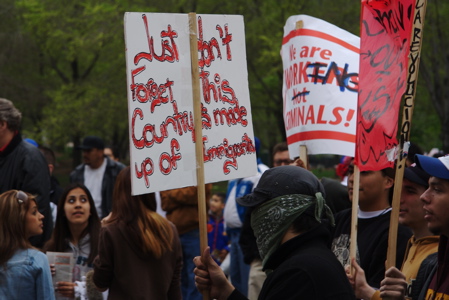
Here, the “this country is made up of immigrants” message is familiar, but I was totally drawn to the protester. What’s up with the mask? (More on that in a minute.) Also, check out the sign in the background: “We Are Workersing Not Criminals!” I saw a few others that read in this exact way; I don’t know if they were printed in that fashion or modified after the fact. Regardless, it’s a strange choice. Would you willingly hold a sign identifying yourself as a criminal?
Back to Mr. Mask. Here’s the front of his sign:

That’s certainly a more provocative message, but does it merit an attempt to disguise his identity? (Note also that this was actually written on top of another, milder message: “Look around you! What do you see? Immigrants!”) The whole mask thing really undercuts the message for me. It makes me think of CNN and firebombs and all sorts of unpleasant things. Not a wise choice.

This is much better. The choice of a chef’s hat is fun and evokes a skill, carrying with it a not-so-subtle reminder that many of these people are hard at work behind the scenes. The “We Love USA” message is similarly open and friendly.
This guy had the same idea:

It’s misspelled, but it’s sweet. I think this is particularly effective because it’s polite and slightly subservient. Couldn’t be more different than the masked man.
Nearby, I saw this gentleman:

He’s working a “we were here first” theme, which I’ll come back to later. For the moment, though, notice the discarded placard near his feet: “We Also Have a Dream!” This is an interesting approach, because it references the struggle (and legitimacy) of the American civil rights movement.
Other signs took the same approach, even invoking MLK:

But are immigration quotas really the same thing as Jim Crow laws?
Some others went a lot further back in time than the ’60s for inspiration:

I call this the “stolen”/”we were here first” theme:
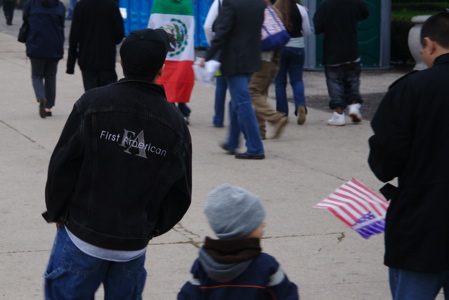
As I see it, there are two major problems with this argument. First, you get into something of a reductio ad absurdum situation. Which governments stole, and which were legitimate? The Spanish? Aztec? Mixtec? Zapotec? Mayan? How far back do you want to go? It seems there are others with a claim:

Secondly, let’s be real here. Is this about living in Denver, or is it about making a living in the richest country in the world?

And on the subject of work, let me show you my pick for least effective sign of the day:

If you spend any amount of time reading up on immigration issues, you’re bound to hear that immigrants “do what Americans won’t” — and since many come from poorer companies (Mexico’s per-capita GDP is a quarter of the USA’s) they do it for cheap. Except: how are these not connected? Supply and demand is the most basic economic principle there is; just increase the pay and you’ll be surprised what Americans will do.
And so what if that makes some goods more expensive? In fact, just imagine the beneficial side effects of more expensive fast food! Or, for that matter, having to cut your own grass… After all, nobody ever said a cheap Big Mac is an inalienable right.
Oh, did I mention a “right”? I’m not the only one:

Typo aside, this sign was one example of the most common themes at the event: “rights”/”justice”/”fairness.” This included everything from speeches (“unfair treatment and unfair wages”, “fair and just immigration reform”) to Statue of Liberty iconography:

Closely linked was the concept of families:

(I saw a similar T-shirt depicting a family with one member missing, the word ‘Deportado’ over his/her outline.)
…and basic humanity:

Except I can’t help thinking that, while it’s indisputably true that “no human being is illegal,” so too is it true that there are illegal acts, with forseeable consequences. If a man sneaks across the border, later brings his family, then is discovered and sent back home, isn’t he ultimately responsible? (After all, by definition it’s impossible to deport citizens.)
Or, perhaps, after a certain amount of time America is his home, and the law should be changed to recognize that.

It’s a tough question.
You know, there are those who point to Brokeback Mountain losing out for Best Picture as proof of Hollywood’s underlying homophobia. That may be — we’ll never know — but at least Brokeback fared better than the movie I saw last night, Making Love.
That picture, a 1982 release, actually began with a warning:
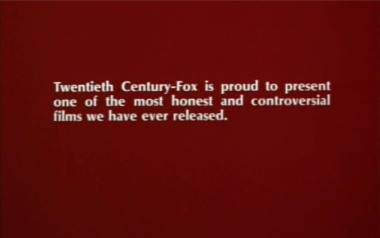

(These stills are from The Celluloid Closet a documentary in which Making Love screenwriter reveals an incoming studio head at Fox referred to the film as “a goddamned faggot picture.” What was that about “proud to present” and “applaud its courage” again?)

If you have not seen Stephen Colbert’s speech at the White House Correspondents’ dinner, you must.
No, seriously. It’s amazing. Colbert has, uh, “nerves” of steel.
As you watch it, remember the president is sitting one chair away. That’s called speaking the truth to power, folks.
Update [Mon 03:57]: Higher-quality torrent (scrub to 52:25, unless you want to watch Bush make the same fucking joke about how he can’t pronounce “nuclear”) and lower-quality YouTube also available.
I was doing some searches related to the whole strategic petroleum issue on CNN yesterday, and got some unexpected results.
For the words Bush gasoline, CNN displayed the following:

I love how it’s not just gas, it’s bulk gas. You really can get anything on eBay! (Or not.)
When I saw this [via TPM], I figured I had to be reading it wrong:
“Our strategic reserve is sufficiently large enough to guard against any major supply disruption over the next few months,” [Bush] said. “So by deferring deposits until the fall we’ll leave a little more oil on the market.”
The amount of remaining oil that was scheduled to be delivered to the reserve was 2.1 million barrels in May, which would supply about two hours of the average 21 million barrels of oil the United States consumes each day. “Every little bit helps,” Bush said.
— Bush unveils plan to counter high oil prices
So hold on now. The president is saying he’s going to allow the oil companies to hold back petroleum reserve deposits until the fall — fair enough. Except (at least as far as May is concerned) that represents just 1/310 of the average usage? Then who the hell cares?
Clearly this is a P.R. move on the part of the Administration, but I have to say the Reuters story is also rather weak on context. If you look at Wikipedia’s entry on the Strategic Petroleum Reserve, for example, you’ll see that the reserve holds some 727 million barrels, and is currently full (a process that took years from the 2001 order.) However, according to the “drawdowns” section, there’s only about 10 million barrels outstanding.
So, assuming demand in May is typical (entirely unlikely, but hang with me), that’s May/June/July/August = 4 * ~600m barrels/mo = 2.4bn barrels consumed. And we’re deferring 10m barrels to get back out in the market? Wow, that’s almost 0.5%! Amazing.
…or maybe I’m missing something altogether. It would be nice if Reuters took a little more time to explain.
Well, here are a few random things I’ve come across in the past week or so that don’t individually merit their own posts, yet amuse me all the same.
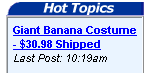
This is from SlickDeals. Good thing I saw it — you never know when you need a good banana costume. (And at that price, you should buy two!)

This is from a TechCrunch article about Google Payments (coming soon.) It’s super small, but the last line reads “‘GOOGLE * BLING BLING’ will appear by the charge on your credit card.” I so hope that’s not the store name. I want Google to write that on customer bills…
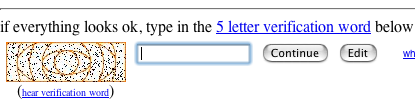
This is a “captcha” thrown up by Craigslist when I posted an (item wanted) ad yesterday. Can you read the word? If so, your eyes are better than mine. I had to hit the audio hint to figure it out. (It’s “weedy.”)
Saw this one on the NYT yesterday. I was seriously confused by the concept of water sponsoring anything, much less a newspaper article. Had to click it to find out it’s a film (from the director of Earth and Fire — any guesses on her next title?)

Finally, there’s nothing I “love” like misplaced quotation marks. Really inspires confidence in the legality of the product, doesn’t it? (Via Slate.)
This afternoon I went for a walk in the park with Debs. As we walked, we noticed a big burly guy “walking” his dog by skating along behind the mutt on inline skates. Though I’ve always found that practice to be unwise, it’s not exactly uncommon. Still, what held our glance was the man’s decision to wear a scarf — an unusual choice given the warm weather (he was in shorts.)
As he came closer, we realized it wasn’t a scarf at all — it was a boa constrictor. Dude was blading around with a dog and a big fat freakin’ snake around his neck.
As if being on wheels when your dog spots a squirrel isn’t challenge enough?
You can’t tell me the fine folks at Loews weren’t having a bit of fun when they created this sign:
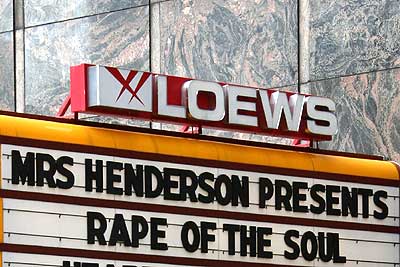
Also, funny story: about 30 seconds after I took this picture this afternoon, Dennis Farina walked by. Pretty sure. I didn’t take his snap because a) I’m not all starfucker and b) I’d already put the camera away.
Mostly b).
I’ve been reading Ricardo Semler’s book Maverick in fits and starts, and yesterday on the train I settled down to get in a few pages. I think I surprised a few people with a quiet “holy shit!” when I hit this passage (p.240, emphasis added):
A new [Brazilian] president, Fernando Collor de Mello, assumed office and appointed a young economist, Zélia Cardoso de Mello (no relation to the president), as finance minister. She proceeded to test some new theories, including one that held that there was too much money in ciculation, that it belonged to too few people, and that they were doing too much speculating with it. Because of this, her theory went, not enough money was being invested in industry. This was generating inflation and stagnation.
So, she thought, let’s take some of that money and give it to the government (which doesn’t have enough, right?). On a sunny spring day in 1990 she went on television to declare a bank holiday and seize 80 percent of the cash in the country. The government laid hold of savings accounts, checking accounts, certificates of deposit, company funds, the works. Every Brazilian, no matter what his assets, was left with $800 or 20 percent of his holdings, whichever was less. If someone had, say, $1,000 in a checking account, he now could spend $200. The lady said she’d give the money back, corrected for inflation by an official index, in twelve monthly installments, starting in a year and a half.
Chaos doesn’t being to describe the reaction.
Wikipedia says Brazil had inflation “exceeding 2,700% in the period of 1989 to 1990.”
Last year when I made mock billboards for Big Print Bank, I made sure to include a reference to payday loans. Ever since my Finance 350 prof required us to calculate the APR on those suckers, I’ve been mortified by the whole industry.
Today I found an interesting tidbit [via] that underscores the whole problem (emphasis added):
The [payday] loan usually ranges from $100 to $500 and requires a fee that can be up to $25 for every $100 borrowed. Annual percentage rates on the loans can be more than 400 percent.
About 170,000 North Carolinians have tapped payday loans, according to the Center for Responsible Lending. The center said that about 99 percent of the loans go to repeat borrowers, and that the average borrower ends up paying $800 to obtain $325 because of the interest cost.
— “Final payday lenders depart N.C.“
So I’m checking up on the torrents site, as one does, and I find this interesting title I haven’t seen before: “mariposaHD.” It’s available in HD (720p and 1080i, Windows Media format) and bills itself as “The World’s First HDTV Show for the Internet.” It’s even available in a Creative Commons license, with free online distribution encouraged! Impressive, eh?
Who are these trendsetters, blazing a trail for high tech, flexible copyright, and new distribution models? What stories are they using all this shiny newness to tell?

Oh. Right.
You know, I’m much less of a Google fanboy than I once was (for causes, see also: Chinese Censorship, Google’s Role in) but I still find plenty to admire in the company.
Take the recent revision to the terms of service for their Google Maps API. In announcing the change, Google provided a helpful “diff” page in which they highlighted the changes in red:
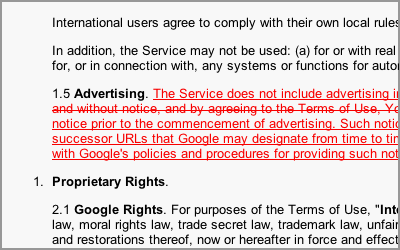
This customer-friendly move shows respect for our time in a way that far, far too few companies bother to do.
For example, contrast that approach to the one taken by PayPal, which by coincidence also recently updated its terms.
PayPal requires the user to signify his/her agreement to the new terms rather than simply changing them unilaterally, which I applaud. But my admiration ends there. Here’s a sample from the screen in which PayPal requests acquiesence to the modified agreement (scaled to 80%):
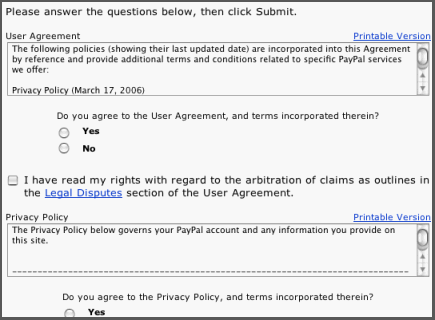
See that first 5-line textbox? It contains over 7,100 words, including a line mentioning that the privacy policy (among other documents) was updated in March 2006. They break out the privacy policy in the lower box, which weighs in at nearly five thousand words. Of these, how many are changed? Not a clue.
This sort of customer-hostile behavior lends a lot of credence to the perspective that PayPal doesn’t really want its customers to actually read the revised terms. Whether this is due to an attempt to slip in new provisions or just plain apathy about usability is less clear.
I know it’s an open secret that nobody reads the fine print before they click “I Agree”, but it would be nice if more companies followed Google’s example here.
Last year, I saw an ad using a (hairy) shirtless man to sell mortgages to gay men.
Last night, I saw this banner ad using a similar approach for het men (imagine it in Flash, with the chick dancing around):

My question: is this the most effective appeal they could create? What was the thinking: “Hey look, it’s a dancing girl in a bikini top — that’ll attract the re-fi market!”
…but this sort of shit (on broadcast TV!) drives me crazy:
